Setswana is an African language spoken in South Africa, Botswana, and parts of Namibia. It is the national language of Botswana, and one of the eleven official languages in South Africa. The language is sometimes referred to as Tswana. Setswana is one of three languages classified as the Sotho subgroup of the languages in the South-eastern Bantu group of the Bantu Language Family. The other two languages in this family are Southern Sotho (Sesotho or Seshweshwe) and Northern Sotho (sometimes referred to as Sepedi). The three languages are mutually intelligible, which means that speakers of these languages can carry on a conversation with each other, each one speaking his or her own language! (National African Language Resource Center (NALRC))
The development of the Setswana language is partly due to the European missionaries whose aim was to translate the Bible into the local languages. Tswana tribes are found in more than two provinces of South Africa, primarily in the North West, where about four million people speak the language. An urbanised variety, which is part slang and not the formal Setswana, is known as Pretoria Sotho, and is the principal unique language of the city of Pretoria.
Sol Plaatje is considered to be one of the most famous Tswana speakers, having played an integral role in the history of our country. He was a journalist, writer and intellectual. He was also a founding member of the South African Native National Congress, a forerunner of the ANC. In addition, he translated some of Shakespeare’s works into Setswana. Purists are disappointed when Setswana is equated with Tswana. They consider the two to be totally separate languages. Setswana speakers are often referred to as Tswanas – a term regarded as erroneous by those who prefer the term Batswana people, even though some linguists argue that it is common practice to drop the language prefix when referring to African languages, hence Tswana (www.sa-venues.com).
DID YOU KNOW?
Setswana was the first language of the Sotho group to have a written form (in 1806), emerging through the work of Heinrich Lichstein (1806), who wrote a book “Upon the Language of the Beetjuana”, the first book about Setswana.
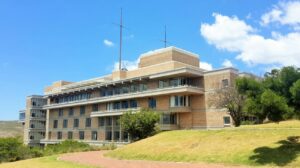
The Monument to the 1820 Settlers (The Heritage Portal)
We South Africans live in a polyglot society, which under our Constitution, has 11 official languages that “must enjoy parity of esteem and must be treated equitably”. Mother tongues range from Afrikaans to IsiZulu, from isiXhosa to Setswana, however to stop us being a modern Tower of Babel we largely use one language to communicate between each other and that is English. In doing so we are reflecting a world wide trend. In today’s world English has become the “Lingua Franca” replacing French as the language of diplomacy and German in the field of science. It has also become one of the essential languages for global trade.
In 21st century South Africa, English is used in many walks of life, in media and advertising, in education, law, commerce and government. English is the language of the big city especially Johannesburg, South Africa’s financial capital. Although should one drive 50 miles (80 km) in any direction out of “Egoli”, you are more likely to hear Afrikaans or an African language being spoken. How is it then that a European colonial language has managed to become so influential?
To answer this question a look at South African history from the beginning of the 19th century is needed.
The English language first came to the southern tip of Africa 1795 when the British occupied the Cape of Good Hope in order to protect their trade with India and the Orient. They left in 1803 as part of the terms of the Treaty of Amiens, but in January 1806 they returned for good, after what was a brief interlude when the Batavian Republic (a French aligned administration) held the Cape. At the time of the Second Occupation, the British had no real policy on the matter of exploring and developing the hinterland and for many years Cape Town remained the “Tavern of the Seas”, merely a port of call between Europe and the East. The people who had the adventurous spirit were the Trek Boers, born of Africa of Dutch descent and even before British annexation they had fanned out to establish farms and settlements in the Overberg to the east of Cape Town and as far afield as Graaff-Reinet and Uitenhage. By 1837 these Trek Boers could no longer stomach British rule and hitched their ox wagons leaving the Cape Colony for good on what is now known as the Great Trek.
The end of the Napoleonic Wars came when the Duke of Wellington defeated Napoleon Bonaparte at the Battle of Waterloo on the 18th June 1815. Although it was widely celebrated, its aftermath brought about an economic recession in Britain which in turn created unemployment and political turmoil. The British government of the day looked to emigration from Britain, to her colonies, as a way to alleviate unemployment. The Colony of the Cape of Good Hope was seen as a suitable destination for those wishing to start a new life as the climate was not too dissimilar to that of the British Isles. And so it was that in 1820 the first settlers arrived in Algoa Bay to farm what is now called the Eastern Cape. The land was not unoccupied as the pastoral Xhosa tribe (Nguni speaking) were already well established and for many years to come there would be outbreaks of war between the British and Xhosa (the Border Wars) over the right to land.
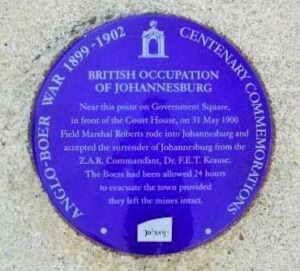
Blue plaque in Gandhi Square near the spot where the Boers surrendered Johannesburg to the British during the South African War (The Heritage Portal)
In the 1840’s the British decided to develop a second colony – the Colony of Natal, which was usurped from the Voortrekkers, who were forced to trek back up country to what became known as the Orange Free State. This action set the tone of relations between the two European colonisers which would end in all out war to determine who would control South Africa – The Boer War 1899-1902.
In truth it was not until the mineral wealth of the interior of South Africa was discovered that Britain took a keen interest and when they did the might of Victorian Britain (the leading economy of the 19th century) financed firstly Kimberley (1870) and then Johannesburg (1886); both were English speaking cities from the word go.
Johannesburg was an English speaking enclave within a Boer state – the South African Republic (a.k.a. Transvaal) – and it would be the powder keg which would ignite the Boer War, a war that so easily could have been avoided, but for intransigence on both sides. The outcome of the war was a British victory at the cost of many lives lost and a lasting resentment by those who had been defeated, which would create the spectre of Afrikaner Nationalism
At the formation of the Union of South Africa, on the 31st May 1910, exactly eight years after the Boer War had ended, English and Dutch were accorded equal status as official languages. No African language was considered worthy by those who had come together at the National Convention (1908-1909) to “horse trade” for the future of South Africa. Although Dutch (and later Afrikaans) were given parity, in reality English remained the language of power and influence mainly due to the fact that South Africa was part of the British Empire (Pax Brittanica).
The rise of Afrikaner Nationalism which heralded the Apartheid era (1948 to 1994) pushed the Afrikaans language to the head of the table. On 31st May 1961, exactly 51 years after Union, South Africa was declared a republic and left the British Commonwealth – a long held dream for Afrikaner hegemony.
During the struggle against Apartheid, South Africa’s Black majority, made up of many language groups, needed a unifying force to rally around and the English language was seen as the ideal instrument to spread the word (internationally) of the injustices that they incurred.
Then it happened, the hubris that the Afrikaner leadership deluded itself with, brought about rioting in June of 1976. The lid on the pressure cooker of resentment finally blew off over the dictate that Afrikaans would be, in future, the medium of instruction in township schools (replacing English). The rioting and the government crackdown that followed will not be elaborated upon suffice to say it was a turning point in South Africa’s history and it mortally wounded the Afrikaner hegemony that would eventually expire in 1994.
On 11th February 1990 Nelson Mandela walked out, a free man, from the Victor Verster Prison in Paarl, 27 years 6 months and 6 days after his capture near Howick Natal. When he spoke from the balcony of the Cape Town City Hall, he spoke in English, so that the world would hear his message “Apartheid has no future”.

Cape Town City Hall (The Heritage Portal)
The English language has both virtues and vices and I feel fervently that the virtues in the 21st century far outweigh the vices. The case of the Republic of Ireland (Eire) may be illuminating for us. The country had strong anti-English sentiments and on gaining its independence from Britain in 1922 (as the Irish Free State) sought Gaelic (Irish) as being the official language to set it apart from its former masters. However, commercial interests and cultural ties (including family) between Ireland, Britain and the United States meant that Gaelic really was a non-starter. Although taught in schools, its relevance to modern everyday life in Ireland is no longer evident. Despite this, it is still a rich source of inspiration for music, poetry and artistic thought and enriches English by association.
The Irish example I hope will apply to the future of South Africa and that local languages (Afrikaans included) will still be robust in keeping culture and traditions alive. In my view, the most practical way forward in a globalised world is for all South Africans to speak at least two languages: their mother tongue and English*. This means that one has the best of both worlds, your home language tells you where you come from and English tells you where it is possible to go
The Afrikaans language, a West Germanic language spoken predominantly in South Africa and Namibia, has an intriguing and multifaceted history that traces back several centuries. The origins of Afrikaans lie in the Dutch colonial period, specifically the 17th century, when Dutch settlers arrived at the Cape of Good Hope.
Arrival of the Dutch
In 1652, Jan van Riebeeck and other Dutch settlers established a refreshment station at what is now Cape Town. The primary objective was to supply ships of the Dutch East India Company with fresh provisions. Over time, this settlement grew, and the Dutch language became the lingua franca of the region. However, the Dutch spoken at the Cape began to evolve separately from the Dutch in Europe, influenced by various factors, including contact with other languages and cultures.
Influence of Other Languages
The Dutch settlers were not isolated. They interacted with indigenous Khoisan people, slaves brought from various parts of Africa, Madagascar, India, and Southeast Asia, as well as other European settlers. This multicultural environment led to the incorporation of words, phrases, and grammatical structures from these diverse languages into the Dutch spoken at the Cape. The result was a unique linguistic blend that would eventually form the basis of Afrikaans.
Development and Divergence from Dutch Early Differences
By the 18th century, the language spoken in the Cape Colony had already begun to show significant differences from standard Dutch. These differences were evident in pronunciation, vocabulary, and syntax. For instance, the simplified grammar and phonetic spelling of Afrikaans differentiated it from the more complex Dutch language.
Written Records
The first written records of Afrikaans date back to the late 17th century, although these were primarily in the form of informal documents such as letters and diaries. One notable early text is a 1795 letter written by a slave named Cupido, which showcases early Afrikaans’ distinct characteristics. By the 19th century, Afrikaans had evolved enough to be recognized as a separate language, distinct from its Dutch parent.
The Role of Missionaries
Missionaries played a pivotal role in the development of written Afrikaans. They used the language in their efforts to educate and convert the local population. The first Afrikaans Bible translation, completed in the early 19th century, was a significant milestone. It helped to standardize the language and provided a reference point for future written works.
Afrikaans in the 19th Century
Recognition and Standardization
The 19th century was a crucial period for the recognition and standardization of Afrikaans. The language gained more prominence, especially among the Afrikaner population, who saw it as a symbol of their identity and independence. Several key events during this period contributed to the formalization of Afrikaans.
The Genootskap van Regte Afrikaners
In 1875, a group of Afrikaner intellectuals founded the Genootskap van Regte Afrikaners (GRA), or the Society of Real Afrikaners. The GRA was dedicated to promoting Afrikaans as a written and spoken language. They published the first Afrikaans newspaper, “Die Afrikaanse Patriot,” and produced educational materials, literature, and grammar guides in Afrikaans. This organization played a vital role in legitimizing Afrikaans as a language in its own right.
First Afrikaans Dictionary
The first Afrikaans dictionary, “Patriot Woordeboek,” was published in 1902 by the GRA. This dictionary was a significant milestone in the standardization of the language, providing a comprehensive list of Afrikaans words and their meanings. It helped to establish a standardized spelling and grammar for the language.
Afrikaans in the 20th Century
Official Recognition
The 20th century saw Afrikaans gain official recognition and prominence in South Africa. In 1925, Afrikaans was officially recognized as one of the two official languages of South Africa, alongside English. This recognition was a significant achievement for the Afrikaner community and solidified Afrikaans’ status as a national language.
Education and Media
Afrikaans became the medium of instruction in schools and universities, further entrenching its position in South African society. The establishment of Afrikaans-language newspapers, radio stations, and later television channels, helped to promote the language and culture. Afrikaans literature also flourished, with authors such as C.J. Langenhoven, Uys Krige, and Breyten Breytenbach making significant contributions to the literary canon.
Political Context
The apartheid era, which lasted from 1948 to 1994, had a profound impact on the Afrikaans language. The National Party, which implemented apartheid policies, promoted Afrikaans as a means of reinforcing Afrikaner identity and nationalism. This period saw a significant increase in the use of Afrikaans in government, education, and media. However, it also led to tensions and resistance, particularly among non-Afrikaner communities who associated Afrikaans with the oppressive regime.
Post-Apartheid Era
Language Policy Changes
With the end of apartheid in 1994, South Africa underwent significant political and social changes. The new democratic government adopted a more inclusive language policy, recognizing 11 official languages, including Afrikaans. This policy aimed to promote multilingualism and ensure that all South African languages were given equal status and opportunities.
Challenges and Resilience
In the post-apartheid era, Afrikaans faced several challenges. The association of the language with the apartheid regime led to a decline in its use and status in some sectors. Additionally, the emphasis on promoting previously marginalized languages and the increasing dominance of English posed further challenges for Afrikaans.
Despite these challenges, Afrikaans has shown resilience. It remains widely spoken and used in various domains, including education, media, and literature. The language has also continued to evolve, incorporating new words and expressions from other languages and adapting to the changing social and cultural landscape of South Africa.
Afrikaans Today
Current Status
Today, Afrikaans is spoken by approximately 7 million people as a first language and by several million more as a second language. It is one of the 11 official languages of South Africa and is also recognized in Namibia. Afrikaans is used in various domains, including education, media, government, and business.
Dialects and Variations
Afrikaans has several regional dialects, reflecting the diverse communities that speak the language. These dialects include Cape Afrikaans, Orange River Afrikaans, and Eastern Border Afrikaans, among others. Each dialect has its own unique features, influenced by the historical, social, and geographical context in which it developed.
Literature and Culture
Afrikaans literature and culture continue to thrive. The language has a rich literary tradition, with authors producing works in various genres, including poetry, novels, and drama. Afrikaans music, theater, and film also play an essential role in the cultural landscape of South Africa.
Conclusion
The history of Afrikaans is a testament to the dynamic and evolving nature of language. From its origins in the Dutch colonial period to its current status as one of South Africa’s official languages, Afrikaans has undergone significant transformations. It has been shaped by various influences, including contact with other languages and cultures, historical events, and political changes.
Despite the challenges it has faced, Afrikaans has shown remarkable resilience and adaptability. It remains an integral part of the linguistic and cultural fabric of South Africa and continues to evolve and thrive in the 21st century. As South Africa moves forward, Afrikaans will undoubtedly continue to play a vital role in the country’s multilingual and multicultural society.